CBN Advert
NAICOM Welcomes New NCRIB President, Mrs. Ekeoma Ezeibe, FCIB – Reaffirms Commitment To Stronger Collaboration And Market Professionalism

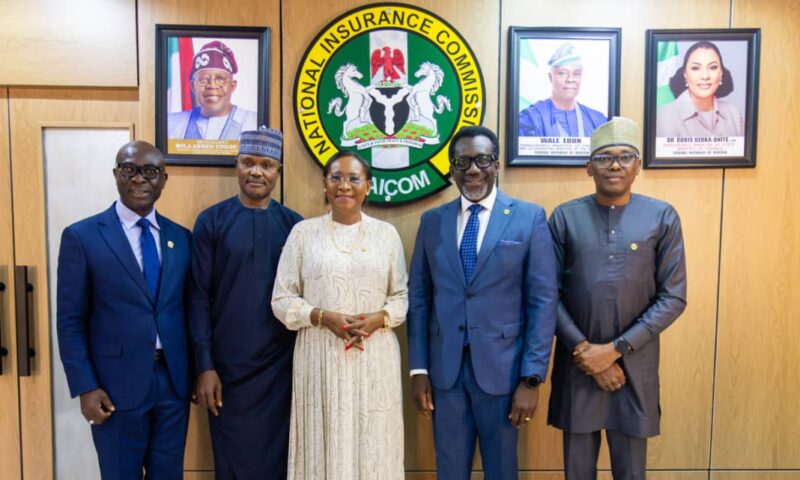
The National Insurance Commission (NAICOM) last week Thursday 13th, November, 2025 received the newly elected President of the Nigerian Council of Registered Insurance Brokers (NCRIB), Mrs. Ekeoma Ezeibe, FCIB, along with members of her Governing Council, on a courtesy visit to the Commission’s headquarters in Abuja.
This visit is Mrs. Ezeibe’s first official engagement with NAICOM following her formal investiture as the 17th President and third female leader of the Council. The meeting provided an opportunity to strengthen existing ties, review ongoing reforms, and align on key priorities under the National Insurance Industry Reform Agenda (NIIRA 2025).
Warm Welcome and Renewed Partnership
The Commissioner for Insurance, Mr. Olusegun Ayo Omosehin, warmly welcomed the delegation and congratulated Mrs. Ezeibe on her well-deserved emergence as President of NCRIB. He described her leadership as “a major milestone for the Council and a reflection of the increasing strength and influence of women in the insurance profession.”
He added:
“We truly value the relationship between NAICOM and NCRIB. As we continue to implement NIIRA 2025, we see the brokerage community as a critical partner in promoting market discipline, driving professionalism, and rebuilding the confidence of Nigerians in the insurance sector. We look forward to a productive and fulfilling collaboration under your leadership.”
The Commissioner was joined by NAICOM’s senior management team, who also expressed confidence in the new leadership of NCRIB and reiterated their support.
NCRIB President Outlines Her Priorities
In her remarks, Mrs. Ekeoma Ezeibe thanked the Commissioner and the entire NAICOM management for the warm reception. She expressed her appreciation for the support the brokerage community has consistently received from the Commission.
She noted that her administration would focus strongly on:
• Strengthening the compliance culture among brokers,
• Improving documentation and communication processes,
• Enhancing the professional image of the brokerage subsector, and
• Promoting continuous training, mentorship, and capacity-building — especially for women and young professionals.
She also clarified that many of the historical compliance issues were not acts of negligence, but often administrative oversights. She assured the Commissioner that the new leadership is committed to addressing these gaps and deepening engagement with NAICOM to foster clarity and shared understanding across the market.
Both NAICOM and NCRIB agreed on several important areas that require joint focus:
1. Professionalism and Ethical Standards
The Commissioner stressed that the brokerage profession must continue to uphold its respected identity as professional advisers, not intermediaries perceived merely in transactional terms. He emphasised the need to reinforce trust and professionalism at every level.
2. Compliance and Documentation Quality
Improving communication, documentation standards, and timely updates across the value chain were highlighted as priorities — as poor documentation sometimes leads to avoidable disputes, particularly around claims.
3. Women Inclusion and Youth Engagement
NAICOM’s management expressed strong support for the President’s plans to expand opportunities for women and to mentor younger practitioners entering the industry.
4. Alignment With NIIRA 2025
Both parties agreed that the successful implementation of NIIRA 2025 requires continuous partnership. The Commissioner noted that brokers have an essential role in driving inclusion, building market trust, and educating consumers.
5. Strengthening Sector Reputation
The meeting emphasised the need for unified messaging and public sensitisation, ensuring Nigerians understand the value of insurance beyond legal obligation.
Agreements and Action Points
The session ended with both sides agreeing to the following:
1. Establish a NAICOM–NCRIB Joint Working Group to jointly address market conduct issues and compliance matters.
2. Expand training and capacity-building programmes for brokers, focusing on ethics, documentation, digital literacy, and client communication.
3. Enhance public awareness initiatives, especially for compulsory insurance classes and the role of brokers.
4. Hold regular engagement meetings between NAICOM and NCRIB leadership to monitor progress, resolve issues early, and sustain transparency.
The Commissioner assured Mrs. Ezeibe of NAICOM’s continued openness and support, noting that “stronger partnerships will help deliver a more trusted, professional, and inclusive insurance market for Nigerians.”
The visit concluded with a warm exchange of goodwill gifts between the Commissioner and the NCRIB President, symbolising mutual respect and ongoing partnership. A group photograph followed, capturing the NAICOM management team, the NCRIB President, and members of her delegation.
Conclusion
The meeting reinforced the longstanding relationship between NAICOM and NCRIB and highlighted a shared commitment to deepening professionalism, strengthening compliance, and driving sustainable growth in the insurance industry.
As reforms under NIIRA 2025 continue, both institutions reaffirmed their pledge to work together to build a more competitive, inclusive, and trusted insurance sector for the benefit of all Nigerians.
FiBOP Honours NAIC With Excellence Award in Supporting Nigeria’s Agricultural Transformation

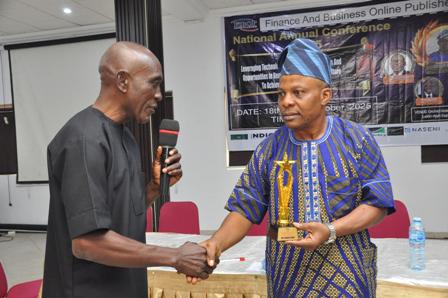
L-R: FiBOP President, Mr Charles Onwuatogwu and NAIC Lagos Branch Manager, Mr Titiloye Oyatolu receiving FiBOP ‘s award of excellence as ‘Nigerian Farmers’ Reliable partner 2025
By Fidelia Okafor
The Nigerian Agricultural Insurance Corporation (NAIC) has been honoured with the prestigious “Farmers’ Most Trusted Partner Award” by the Finance and Business Online Publishers (FiBOP) Association.
The recognition underscores NAIC’s pivotal role in strengthening Nigeria’s agricultural sector and its sustained efforts toward achieving national food security and economic resilience.
Presenting the award at NAIC’s Branch office in Lagos, the President of FiBOP, Mr. Charles Onwuatogwu, said NAIC was selected for the award for contributing meaningfully to Nigeria’s agricultural development.
He said the Corporation’s consistency in providing insurance protection to farmers across the country has not only helped stabilise the sector but also ensured that agricultural investments remain viable despite the increasing risks posed by climate change and other uncertainties.
“Over the years, NAIC has distinguished itself as a reliable partner for farmers, ensuring that agriculture remains a key driver of Nigeria’s economic prosperity,” Onwuatogwu said.
He added that the Corporation’s role in safeguarding farmers’ livelihoods through insurance interventions directly supports the federal government’s drive toward food security and national prosperity.
Receiving the award in Lagos on behalf of the Managing Director and Chief Executive Officer of NAIC, Hon. Yazid Shehu Umar Danfulani, the Lagos Branch Manager, Mr. Titiloye Oyatolu, expressed deep appreciation to FiBOP for the recognition.
He described the award as a strong motivation for NAIC to sustain its commitment to the nation’s agricultural transformation agenda. “This award reaffirms our mission to serve Nigerian farmers better and to continue building resilience within the agricultural ecosystem,” Oyatolu said.
Oyatolu highlighted some of NAIC’s key insurance products and services, which include Crop Insurance, Livestock Insurance, Farm Assets and Produce Insurance, and Multi-Peril Insurance Schemes designed to protect farmers against losses from natural disasters, pests, and diseases.
He emphasized that through these innovative offerings, NAIC has provided a safety net that encourages investment in agriculture at all levels — from smallholder farmers to commercial agribusinesses.
He further noted that NAIC’s adoption of modern technology and digital innovation has enhanced the efficiency of its operations and improved accessibility for farmers nationwide.
With tools for risk assessment, claims processing, and customer engagement now streamlined through digital platforms, the Corporation continues to play a strategic role in driving growth and sustainability within Nigeria’s agricultural ecosystem. “We remain steadfast in our resolve to empower farmers and support the nation’s journey toward food sufficiency,” Oyatolu concluded.
AFRIMA Launches Diamond Showcase Portal, Invites Rising Stars To Apply

The journey to discover and celebrate Africa’s future music stars has begun, as the 9th Edition of the All Africa Music Awards (AFRIMA) has opened the application portal for its Diamond Showcase, the award institution’s platform for rising music talents.

The 9th AFRIMA Diamond Showcase is designed to give undiscovered African artists a real chance to present their music to a wider audience and take a major step toward mainstream success.

The Showcase welcomes singers, rappers, DJs, producers, and instrumentalists from all parts of the continent to apply and take their place on one of Africa’s most respected music stages.

Janatte Haddadi, Regional Manager, Northern Africa for AFRIMA, described the Showcase as a rare and valuable opportunity for young creatives who are ready to grow. she explained that AFRIMA is committed to finding, mentoring, and promoting new African music stars who often remain unnoticed in their communities even though they have strong talent.

Haddadi announced that applications will run from November 18 to December 8, 2025, and she encouraged all interested artists to apply early through www.afrima.org/Diamond-Showcase or AFRIMA’s official Instagram page.

To apply, artists must submit a 45-second performance video. The AFRIMA Jury will then review all entries and select the top 15 finalists, known as “The Diamonds,” who will be invited to Lagos for the live Showcase.

Haddadi said, “We want to find the brightest diamonds in the rough across Africa. There are young artists in small towns, big cities, and everywhere in between who are doing amazing things with their music. Many of them have never had the chance to stand before the people who can help shape their careers. The Diamond Showcase is here to bridge that gap.”

The selected finalists will be hosted in Lagos, Nigeria, from January 6 to 7, 2026, with performances each evening from 7:00 PM to 11:00 PM. The Showcase is part of the activities leading up to the 9th AFRIMA Awards.

Those selected will receive an all-expense-paid trip to Lagos, special AFRIMA gifts, mentorship opportunities, and the chance to perform in front of top music executives, major media platforms, and key industry leaders.

Haddadi urged young talents not to waste the opportunity. “If you believe in your gift, this is the time to act,” she said. “Don’t wait. Don’t hold back. Submit your entry. Africa is ready to meet its next big talents, and we are ready to support your first major step.”

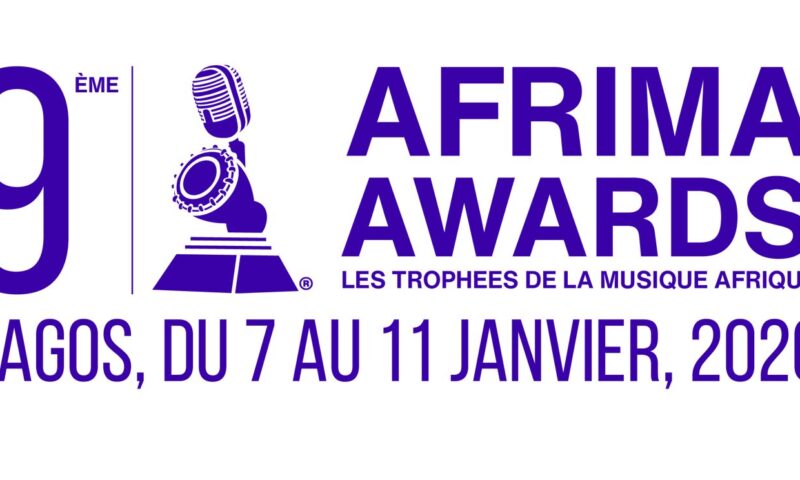
Unarguably Africa’s global music awards, the 9th AFRIMA Awards will take place in Lagos, Nigeria, from January 7 to 11, 2026, with events including the Africa Music Business Summit, the Diamond Showcase, the Music Village Concert, the Nominees Party, the Red Carpet, and the grand Awards Night. In partnership with the African Union and Lagos State (Official Host City), the ceremony will be broadcast live to more than 84 countries globally.

A Dangerous Concentration Of  Power: Is CBN’s Fixed Income Securities Takeover A Ticking Bomb For Nigeria’s Economy?  

BY BLAISE UDUNZE
The Central Bank of Nigeria’s decision to take full control of government securities issuance has been described by some as a bold move toward transparency and market efficiency. Yet, beneath the surface of this reform lies a web of structural dangers that could tighten credit even further, push interest rates higher, escalate exchange-rate instability, trigger regulatory turf wars, and strangulate the private sector, especially small and medium enterprises (SMEs) that already struggle to survive in Nigeria’s high-cost economy.
The policy shift became more pronounced with the rollout of a new Treasury Bills (T-Bills) auction regime, mandating that all bids be submitted through the CBN’s S4 digital interface. This transition officially bypasses the longstanding Primary Dealer Market Maker (PDMM) framework and represents the clearest sign yet that the apex bank is asserting complete control over how government securities are issued, priced, and distributed. In fact, the first major test of this system will occur with the federal government’s planned N700 billion T-Bills issuance scheduled for November 20, 2025 which is an unprecedented rollout that effectively transfers auction power from market intermediaries directly to the CBN.
Analysts say this shift is not merely operational; it is structural. The S4 interface, which has existed since 2014 but never fully deployed as the primary submission platform, now becomes the exclusive gateway for government securities issuance. All bids, whether retail or institutional must be lodged through S4 between 8:00 a.m. and 11:00 a.m., with the CBN maintaining full discretion to adjust the offer amount or reject bids it considers inconsistent with market conditions. Settlement will occur within 24 hours.
According to market expert Tajudeen Olayinka, CEO of Wyoming Capital Partners, the policy “is consistent with the CBN’s signal that it would take charge of the primary segment of the fixed-income market where government securities are issued.” Another veteran dealer put it more bluntly: “With S4, no dealer can see what rate others are quoting. All bids now meet at the same window. This dismantles the old advantage PDMMs enjoyed.”
Although transparency is improved by removing dealers’ visibility over competing bids, concerns have intensified over the broader consequences of the CBN monopolizing the government securities market. The danger is that this reform which is unaccompanied by strong institutional coordination between the CBN, the DMO, and the Ministry of Finance could trigger deeper systemic imbalances.
One of the most pressing fears is the crowding-out effect. If the CBN aggressively issues more government securities as part of its liquidity-management operations, banks, already heavily invested in government debt, will divert even more of their portfolios toward these risk-free instruments rather than lending to the real economy.
Nigeria’s top five banks known as the FUGAZ group (First HoldCo, UBA, GTCO, Access Corp, and Zenith Bank) provide compelling evidence of this shift. Their financial statements show a combined N49.152 trillion investment in securities and Treasury Bills as of September 2025, a sharp rise from N42.204 trillion at the end of 2024. In just nine months, they added nearly N7 trillion to these holdings.
Interest income from these investments surged by 33 percent, hitting N4.8 trillion in the first nine months of 2025 compared to N3.6 trillion in the same period of 2024.
–       Access Corporation led the pack with N15.25 trillion in securities holdings,
–       followed by UBA with N13.59 trillion,
–       Zenith at N9.05 trillion,
–       First HoldCo with N6.35 trillion, and
–       GTCO at N4.91 trillion.
These investments generated robust returns: Access earned N1.3 trillion; Zenith N1.14 trillion; UBA N1.03 trillion; FBN HoldCo N720 billion; and GTCO N570 billion.
For analysts, these numbers expose a structural vulnerability as Nigerian banks are quickly transforming into large-scale government lenders rather than engines of private-sector credit. As Dr. Muktar Mohammed of Lagos Business School explains, “Banks have found refuge in government instruments because they are safe, liquid, and yield high returns in a volatile economy, but this behaviour constrains credit growth to the real sector.”
Lending data confirms this.
–       Zenith Bank’s loan-to-deposit ratio slipped from 43 to 40 percent;
–       Access Corporation maintained a flat 41.2 percent despite rising deposits;
–       UBA’s ratio dropped to 28.2 percent;
–       GTCO’s remained stagnant; and only
–       First HoldCo showed notable improvement.
This trend is dangerous. Nigeria’s private sector, especially SMEs is already starved of credit. Lending rates hover between 28 percent and 35 percent, making capital unaffordable for most small businesses.
With the CBN taking full control of securities issuance, the likelihood is high that more liquidity will be absorbed through T-Bills and OMO bills, pushing interest rates further upward. The more attractive government securities become, the less incentive banks will have to lend to SMEs. This is how economies slide into cycles of low productivity, high unemployment, and weak domestic investment.
The implications do not end there. Excessive issuance of government securities could also destabilize the exchange rate. When interest rates remain artificially high to attract foreign portfolio investors into T-Bills, Nigeria becomes dependent on “hot money” which turns out to be short-term foreign inflows that exit the economy at the slightest shock. This pattern has historically triggered sharp naira depreciation, panic in the FX markets, and severe liquidity shortages in the banking sector. If the CBN uses this securities-controlled regime to sustain high yields, Nigeria risks attracting unstable capital inflows that will exit rapidly, putting pressure on the naira.
Beyond monetary and credit risks, there is a troubling regulatory dimension. The CBN’s move to migrate fixed-income trading and settlement from the FMDQ Securities Exchange, which is under SEC oversight to its own Real-Time Gross Settlement (RTGS) and S4 platforms has ignited a full-blown turf war between the CBN and the Securities and Exchange Commission.
Under the Investments and Securities Act (ISA) 2025, the SEC holds exclusive authority over trading venues. Critics warn that the CBN’s attempt to operate exchange-like infrastructure violates statutory boundaries and risks destabilizing the market.
Dr. Akin Olaniyan, CEO of Charterhouse Limited, described the move as “a potential recipe for dual regulation and confusion,” arguing that it may undermine investor confidence. Similarly, Dr. Walker Ogogo, pioneer Registrar of the Institute of Capital Market Registrars, noted that since the CBN already owns 16 percent of FMDQ, operating parallel infrastructure creates conflicts of interest that send negative signals to foreign investors.
MoneyCentral reports that the migration could trigger a 67 percent drop in FMDQ’s trading volume, weakening a system that has long supported Nigeria’s fixed-income ecosystem.
Veteran banker Victor Ogiemwonyi stated, “the CBN is not an exchange; it should not be involved in issuing, dealing, and settling securities. Conflating these roles creates unnecessary risk.” His concerns are grounded in the principle that market operators must be independent from regulators to prevent conflicts of interest. The CBN’s dual role as both regulator and operator blurs these lines and may set a dangerous precedent.
The real casualties of these structural conflicts will be SMEs and the broader private sector. These enterprises rely on bank credit to fund inventory, acquire machinery, expand operations, and withstand economic shocks. When banks prefer government securities over lending,
–       SMEs face higher rates,
–       stricter collateral requirements,
–       fewer loan products, and shorter tenors.
–       Many will be forced to downsize, lay off workers, or close altogether.
In an economy where SMEs account for over 90% of jobs, this contraction would be disastrous.
Another major overarching risk is that:
–       The CBN’s consolidation of securities issuance power without corresponding checks from the DMO and Ministry of Finance creates an unbalanced financial architecture where monetary priorities overshadow fiscal realities and private-sector growth.
–       Policies crafted in silos rarely produce macroeconomic stability. They produce distortions, uncertainty, and systemic fragility.
Nigeria stands at a critical junction. Securities issuance can be made transparent without centralizing all power in the CBN. Fixed-income markets can be cleaned up without dismantling the institutional balance that preserves confidence. What the country needs is coordination, not consolidation; collaboration, not domination.
If the CBN continues its takeover without robust guardrails, the result may be a financial system where banks stop lending, SMEs continue to collapse, interest rates remain high, the naira stays volatile, and regulatory conflicts scare away both local and foreign investors.
To avoid the dangerous risks ahead, Nigeria must:
1.     Strengthen collaboration between CBN, DMO, and Ministry of Finance. Debt issuance must reflect both monetary and fiscal realities not just liquidity needs.
2.     Prioritize long-term bonds over short-term T-Bills. This reduces rollover risk and provides stable funding at lower long-term cost.
3.     Implement SME-focused credit interventions through private banks, not direct CBN lending. Monetary policy should not attempt to replace commercial banking.
4.     Reduce government’s domestic borrowing needs. This requires fiscal reforms, spending discipline, and revenue expansion not more debt.
5.     Protect private-sector credit allocation. Regulators should discourage excessive bank investment in government securities.
Without these safeguards, the economy risks tilting dangerously toward monetary domination and private-sector suffocation.
The gains of transparency cannot come at the cost of institutional imbalance. Nigeria’s economic recovery depends on a thriving private sector, not an expanding government debt market. The central bank must not become the single most powerful issuer, dealer, regulator, and judge in its own market. That path leads not to stability but to systemic risk, risk that Nigeria’s fragile economy can ill afford.
Meanwhile, it is important for CBN to provide clarity on the economic rationale behind this centralisation of power. The CBN must come forward to justify how this shift will tangibly benefit the economy, particularly in the areas most sensitive to credit availability, financial stability and stability for Nigeria’s broader economy.
Blaise, a journalist and PR professional writes from Lagos, can be reached via: blaise.udunze@gmail.com
Top Tech, Marketing Leaders Set To Drive Conversations At BJAN 2025 Annual Conference

By Winifred Bosa

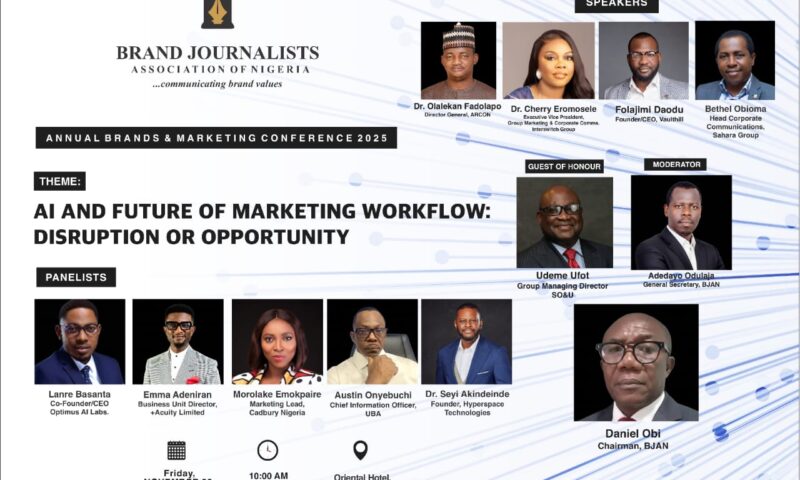
Brand Journalists Association of Nigeria (BJAN) has unveiled a distinguished roster of speakers and panelists for its 2025 Annual Conference, an event designed to examine how artificial intelligence (AI) is reshaping the future of marketing and business operations across Nigeria.

Themed “AI and Future of Marketing Workflow: Disruption or Opportunity,” this year’s conference will take place on November 28, 2025, at the Oriental Hotel, Victoria Island, Lagos.

The annual gathering, now regarded as one of the most influential knowledge-sharing platforms in Nigeria’s integrated marketing communications (IMC) space, will bring together leaders from advertising, public relations, technology, fintech, banking, telecommunications, and brand management.

With AI rapidly transforming how brands engage consumers and optimize marketing processes, the 2025 edition aims to help industry players deepen their understanding of emerging trends and the innovations shaping tomorrow’s marketplace.

This year’s conference will be chaired by Mr. Udeme Ufot, Group Chief Executive Officer of SO&U Limited, one of the country’s leading advertising agencies.

Renowned for his role in advancing creative excellence and strategic communication, Ufot is expected to steer discussions toward the technological shifts redefining marketing practice globally.

The conference features a diverse mix of experts who are driving transformation across industries.

Key speakers include: Dr. Cherry Eromosele, Executive Vice President, Group Marketing & Corporate Communications, Interswitch Group; Mr. Folajimi Daodu, Chief Executive Officer, Vault Hill; Dr. Lekan Fadolapo, Director-General, Advertising Regulatory Council of Nigeria (ARCON) and Bethel Obioma, Head, Corporate Communications, Sahara Group.

Their presentations will highlight major opportunities in AI adoption, regulatory considerations, and the evolving expectations of stakeholders in a digital-first economy.

A major highlight of the event will be the panel discussion featuring a blend of seasoned professionals and innovators from technology, banking, and marketing; Emma Adeniran, ICT Expert; Morolake Emokpaire, Marketing Lead, Cadbury Nigeria Plc; Lanre Basamta, CEO/Co-founder, Optimus AI Labs; Austin Onyebuchi Akosa, Chief Information Officer, UBA and Dr. Seyi Akindeinde, Founder, Hyperspace Technologies

The panel will dissect the practical realities of AI deployment—from data governance and ethical concerns to automation, customer experience enhancement, and the skills required for future-ready marketing teams.

Speaking on the vision for this year’s conference, BJAN Chairman, Mr. Daniel Obi, emphasized the critical role of AI in modern marketing. According to him, AI is no longer a distant aspiration but a powerful tool currently reshaping global industries.

He noted that BJAN’s mission is to create a platform where industry practitioners can better understand the opportunities and challenges presented by AI adoption.

Obi said the conference will expose participants to insights that will help brands become more competitive, efficient, and consumer-centric.

“We aim to foster constructive engagement among professionals from advertising, PR, brand management, corporate communications, and the wider IMC ecosystem,” he said.

BJAN’s annual conference has earned a reputation as a must-attend event for professionals keen on staying ahead of industry shifts.

Over the years, the platform has facilitated knowledge exchange, strengthened industry collaboration, and injected fresh perspectives into Nigeria’s evolving marketing and communications landscape.

The 2025 edition is expected to continue this tradition by: Inspiring new ideas on AI’s role in marketing workflow optimization; Driving conversations around regulatory compliance and ethical AI usage; Connecting business leaders with technology innovators; and Providing opportunities for networking and strategic partnerships.

As the IMC sector faces rapid digital transformation, the BJAN 2025 Annual Conference aims to equip marketers, regulators, and corporate leaders with the insights needed to navigate AI’s growing influence while harnessing its full potential.