CBN Advert
Seplat Energy Appoints Mohammed, Ettah As Independent Non-Executive Directors

Seplat Energy Appoints Mohammed, Ettah As Independent Non-Executive  Directors • Channels Television

The Board of Seplat Energy today announces the appointment of Engineer Saidu Aliyu Mohammed and Mr. Larry Ephraim Ettah as Independent Non-Executive Directors of the Company with effect from 1 January 2026. 

Following the resignation of Mr. Bello Rabiu and Mr. Babs Omotowa from the Board in April 2025 due to their appointments to the Board of NNPC Limited by the President of the Federal Republic of Nigeria, the Company embarked on the recruitment process for their replacements in line with the Board of Directors’ Succession Plan and today announces the appointment of Engineer Saidu Aliyu Mohammed and Mr. Larry Ephraim Ettah as Independent Non-Executive Directors of the Company effective 1 January  2026.

Engr. Saidu Aliyu Mohammed is a seasoned energy executive with over 37 years of experience in the oil and gas industry, specializing in natural gas development, commercialization, and infrastructure. He served as Group Executive Director/Chief Operating Officer, Gas & Power Directorate at the Nigerian National Petroleum Corporation (NNPC), where he provided strategic leadership for major gas projects and policy frameworks, including the Gas Masterplan, Gas Network Code, and contributions to the Petroleum Industry Act (PIA).


He played a pivotal role in conceptualizing and delivering critical gas infrastructure projects such as the Escravos–Lagos Pipeline Expansion, Ajaokuta–Kaduna–Kano (AKK) Gas Pipeline, and Nigeria LNG Train 7. His leadership extended to international engagements, representing Nigeria at the Gas Exporting Countries Forum (GECF) and the West African Gas Pipeline Authority.


Engr. Mohammed previously held top executive positions as Managing Director of Kaduna Refining and Petrochemical Company, Managing Director of Nigerian Gas Company, and chaired boards of several strategic entities, including West African Gas Pipeline Company, Nigeria LNG subsidiaries, and NNPC Retail. He is a Fellow of the Nigerian Society of Engineers (FNSE) and the Nigerian Society of Chemical Engineers (FNSCHE), and a registered engineer with COREN. He holds a B.Eng. in Chemical Engineering from Ahmadu Bello University, Zaria.


Mr. Larry Ephraim Ettah is a highly respected Nigerian business leader with nearly four decades of corporate experience. He spent 30 years at UAC of Nigeria Plc (UACN), rising from Management Trainee in 1988 to Group Managing Director/CEO, a role he held from 2007 to 2018. As CEO, he reshaped UACN’s portfolio through strategic partnerships with global firms such as Tiger Brands, Imperial Logistics, and Famous Brands.

 He also led key acquisitions including Livestock Feeds Plc and Portland Paints Plc, repositioning the conglomerate for sustainable growth across multiple sectors.

Following his retirement from UACN, Mr. Ettah founded Barracuda Capital Partners Ltd in 2018, where he serves as Executive Chairman. He holds several board roles, including Founding Director of Coronation Merchant Bank Ltd and Non-Executive Director of Mixta Africa Plc, and until February 2025, he co-chaired the board of LEAP Africa. He has chaired and served on the boards of several publicly listed companies and advised major consumer goods firms.

 He has played influential roles in industry associations such as Nigeria Employers’ Consultative Association (NECA), Manufacturers Association of Nigeria (MAN), and Lagos Chamber of Commerce and Industry (LCCI), and contributed to national economic policy through presidential and technical advisory committees.

Mr. Ettah holds a B.Sc. in Industrial Chemistry and an MBA from the University of Benin, complemented by extensive executive education from leading global institutions including Harvard, Stanford, Oxford, INSEAD, IMD, and the University of Michigan. His international exposure, strong governance expertise, and broad sector experience underpin his reputation as a strategic, principled, and effective boardroom leader. Overall, he is recognized for his vision, leadership, and commitment to corporate excellence and economic development.


Mr. Udoma Udo Udoma, Chairman of Seplat Energy commented: “On behalf of Seplat Energy, I am delighted to welcome Engineer Saidu Aliyu Mohammed and Mr. Larry Ephraim Ettah to the Board. Their experiences are complementary, combining extensive industry knowledge with extensive business success. We look forward to the significant contributions they will make in advancing the Company’s strategic growth objectives and driving our continued success”

ROADBLOCK Clinches Dual BJAN Honours As Nigeria’s Top Dance Event And Rave Project

ROADBLOCK has been officially voted Nigeria’s Biggest Dance Event and Nigeria’s Most Modern Rave Project 2025 by the Brand Journalists Association of Nigeria (BJAN), a prestigious recognition celebrating innovation, cultural influence, and youth engagement in the Nigerian entertainment landscape.

This was contained in a statement signed by the 2025 BJAN Awards Committee Chairman, Mr. Lukman Ayobami Ishau, and titled ‘Announcing Roadblock as the Biggest Dance/Engagement Event 2025’.

The letter, which was sent to the Founder/Chief Experience Architect of ROADBLOCK, Dr. Felix King Eiremiokhae, stated that “On behalf of the Brand Journalists Association of Nigeria (BJAN) Awards Committee, it is with great enthusiasm that we announce that Roadblock has been voted Nigeria’s Biggest Dance Event for 2025.”

The statement added, “This landmark recognition celebrates a movement that continues to redefine nightlife and ADM (African Dance Music) culture across the country. Roadblock’s unparalleled energy, innovative programming, and unwavering commitment to showcasing homegrown talent have set a new benchmark for dance events in Nigeria.

The award will be presented at the upcoming BJAN Marketing Conference/Awards ceremony, where we look forward to honoring the visionaries behind Roadblock and sharing this milestone with industry peers, artists, and fans alike.”

According to Ishau, “We trust that this recognition will further amplify the impact of Roadblock and inspire even greater creativity within Nigeria’s Afrobeat and Afro Dance Music scenes. Thank you for your continued support in promoting the vibrant cultural landscape of our nation.”

Speaking on the development, Dr. Eiremiokhae said, “This landmark announcement has solidified Roadblock’s position as the country’s leading modern rave movement, pushing forward the new genre and culture known as ADM (Afro Dance Music) while redefining the future of nightlife, festival culture, and experiential youth entertainment across Africa.”

The formal crowning ceremony will take place during the BJAN National Conference, scheduled for November 28, 2025, in Lagos. The event will bring together top brand custodians, media executives, cultural influencers, and industry leaders as Roadblock receives these distinguished honours.

Dr. Eiremiokhae, expressed gratitude to BJAN and to the thousands of young ravers who have embraced the movement adding that “This award is a historic milestone, not just for Roadblock but for Nigerian youth culture. ADM is becoming a voice, a movement and an energy beyond anything we imagined. We are honoured to be seen, to be celebrated, and to lead the new wave of African dance experiences.”

This award precedes Roadblock’s highly anticipated December edition, themed: ‘RISE. REBEL. GET DETTY.

“Roadblock will continue to champion creativity, dance culture, and immersive youth experiences, setting new standards in festival production, stagecraft, and cultural storytelling,” he added.

Sterling Bank Champions Collective Action……To Accelerate Nigeria’s Renewable Energy Transition

L-R: Mr. Ayo Ademilua, President, Renewable Energy Association of Nigeria; Dr. Jekwu Ozoemene, Group Executive, The Alternative Bank; Mr. Biodun Ogunleye, The Honourable Commissioner, Lagos State Ministry of Energy and Mineral Resources; Mr. Dele Faseemo, Group Executive, Coprporate and Investment Banking, Sterling Bank; Engr. Bem Samuel Anyangeuor, Representative, Honorable Minister of Power and Mr. Oluwaseyi Okunnuga, Group Head, Renewable Energy & Sustainability Finance, Sterling Bank at the just concluded Renewable Energy Colloquium held in Lagos recently.
Sterling Bank Limited has brought together stakeholders in the renewable energy industry to explore ways to accelerate action in the sector.
The premier colloquium, held in Lagos on Monday, aimed to identify priority areas for action to increase energy access and drive economic growth in the quest to attain a one trillion-dollar economy.
Managing Director and CEO of Sterling Bank Limited, Mr. Abubakar Suleiman, gave the charge in his address at the colloquium organized with the theme: Beyond The Grid; Unlocking New Frontiers in Renewable Energy.
The   CEO,   who   was   represented   by   Dele   Faseemo,   Group   Executive, Corporate & Investment Banking, explained that Sterling Bank will be paying closer attention to policy actions in two or three key priority areas, especially regulation and financing.
He noted that by focusing on these areas, the Bank can do more  to   drive   progress  and expand access to energy, which he described   as   essential   for   supporting   economic   growth   and   overall development.
In a keynote address titled Scaling Electrification in Nigeria, The REA Impact, Managing Director and CEO of The Rural Electrification Agency (REA), Dr. Abba Aliyu, spoke on the vision, mission and mandate of the agency.
He noted that Nigeria requires about $26 billion to address its energy deficit. He said the energy transition in Nigeria is a strategic shift towards achieving universal, reliable and sustainable energy access by integrating the grid, mini-grid and off grid technologies while aligning with national development and climate goals.
The CEO who was represented by Mr. Abba Hayatudden, Senior Advisor to the   MD,   said  “REA  is  strategically  expanding  and  optimizing  channels  to accelerate the adoption and sustainable growth of renewable energy acrossthe   country   in   the   areas   of   value   chain   development,   regulation enhancement,   funding   windows,   alternative   resources   and   technical standardization.”
Minister   of   Power,   Adebayo   Adelabu,   commended   Sterling   Bank   for convening the conversation on renewable energy.
He stated that the Federal Government has placed renewable energy and rural electrification at the heart of the Renewed Hope Agenda.
The minister who was represented by Engineer Samuel Ayangeaor said, “The Federal   Ministry   of   Power   has   continued   to   expand   electricity   access   to underserved communities in a bid to drive economic growth, foster industrial activity and create jobs across the nation.”
In his goodwill message, Mr. Biodun Ogunleye, Lagos State Commissioner for Energy   and   Mineral   Resources,   noted   that   the   current   administration   is implementing the most ambitious energy transformation ever undertaken.
He highlighted the state’s efforts in renewable energy and sustainability, including the two-gigawatt Lagos grid scale solar project.
The CEO of Sterling One Foundation, Mrs. Olapeju Ibekwe, emphasized the need for collective action. She urged participants not to allow the day’s deliberations   to   end   as   mere   conversations   or   points   documented   in   a communiqué.
Instead, she encouraged everyone to leverage the strength of their   networks,   act   with   intention,   and   remain   focused   on   delivering meaningful impact.
The colloquium featured two panel sessions on financing and scaling green energy solutions in Africa, among others.
Lagos State Applauds Leadway, Ouida For Inspiring Festember Read Along With Onakoya And Shoneyin


Leadway Group, one of Nigeria’s foremost non-banking financial services providers, has received commendation from the Lagos State Government. This followed Leadway Group and Ouida’s successful hosting of the 2025 Lagos Festember Read-Along Initiative, a platform that spotlights and simplifies access to the city’s diverse arts, literary, and creative experiences.


This year’s edition brought together pupils from schools and learning centers across Lagos for an enriching reading session. It featured Guinness World Record holder, celebrated Chess Advocate, Founder of Chess in Slums Africa, Tunde Onakoya, alongside renowned Author and Publisher, Lola Shoneyin. They led the reading of her book, “Tunde Onakoya, The Chess Champion,” a story that explores his journey of grit, vision, and impact from the chessboard.


This strategic partnership aligns with Leadway’s mission to inspire learning, creativity, and community impact. The collaboration fosters cultural engagement and sparks curiosity, imagination, and a love of storytelling among young learners.
Speaking on the initiative, the Brand Communication Manager of Leadway Group, Niyi Abiola, said the Read-Along reinforces the Group’s long-standing commitment to education, creativity, and cultural preservation across generations.


“Through this Read-Along initiative, we want to reignite a love for books among children by connecting them with influential innovators, creatives, and storytellers. Seeing children connect deeply with Tunde Onakoya’s story reminds us why platforms like this matter. When young learners engage with stories, they imagine broader possibilities, build empathy, and strengthen critical-thinking skills. These are the foundations of productive future citizens. We are proud to contribute meaningfully to that journey.”


Representing the Lagos State Universal Basic Education Board (SUBEB), Mrs. Busola Williams commended Leadway Group and Ouida for launching an initiative that develops literacy. She emphasised that the program brings relatable Nigerian stories directly to children. She affirmed that these efforts align strongly with Lagos State’s commitment to improving reading culture and educational outcomes in public schools.


The initiative also helped the young learners engage with curated books, participate in guided discussions led by facilitators, and explore new ideas shaped by storytelling. These efforts aim to improve learning outcomes and expand access to knowledge for children across Nigeria.


Leadway’s involvement aligns with its broader educational interventions. These include previous book donation drives, youth empowerment programmes, and mentorship efforts such as the Pages to Places Initiative. This collaboration highlights Leadway Group’s commitment to strengthening literacy as a catalyst for critical thinking, innovation, and enduring national development.


About Leadway Group

Leadway Group is a leading non-banking financial services organisation in Nigeria with strong expertise in Insurance, Pension Administration, Investment, and other financial solutions. Backed by decades of industry leadership, Leadway continues to play a pivotal role in shaping Nigeria’s economic landscape. The organisation focuses on corporate social responsibility, community development, youth empowerment, and initiatives that promote national progress.

Polaris Bank Champions Girls’ Hygiene Awareness With Female Hygiene Essentials Distribution In Kuramo & Victoria Island Junior And Senior Secondary Schools

Amaka Obiefuna


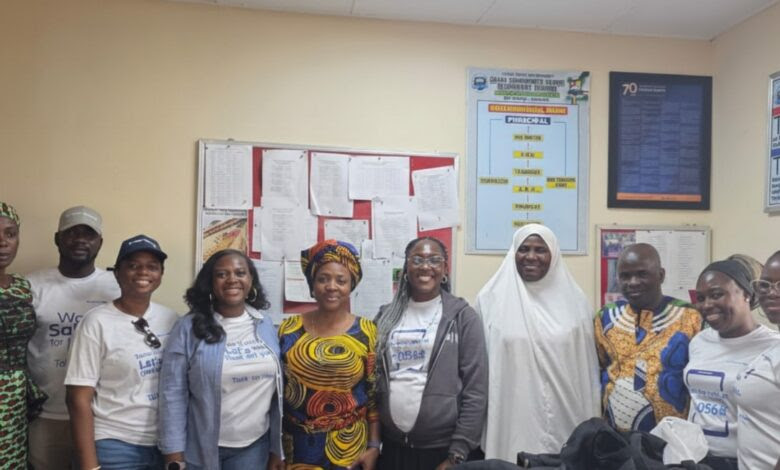
Polaris Bank has continued its commitment to empowering the Nigerian girl-child through health education and essential support, with the successful distribution of female hygiene essentials to female students of Kuramo and Victoria Island Junior and Senior Secondary Schools, Lagos.


This initiative stems from Polaris Bank’s 2025 International Women’s Day celebration and forms part of our ongoing Adolescent Health and Hygiene Support Programme.


Through the Bank’s Girl-Child Support and Hygiene Education Initiative, the outreach aims to improve menstrual hygiene education, build confidence and dignity among young girls, and reduce school absenteeism resulting from lack of access to sanitary products.


Speaking at the event, Group Head, Customer Experience & Value Management, Polaris Bank, Mrs. Bukola Oluyadi, delivered a practical health talk to the girls, emphasizing the importance of maintaining proper hygiene during their menstrual cycle and in their daily lives.


She advised the students on essential personal care practices including the appropriate use of sanitary pads, the importance of daily use of clean underwear, and maintaining good body hygiene with deodorants and regular washing, especially during puberty when their bodies are developing.


“Your body is precious, and how you take care of it determines your confidence and wellbeing,” Mrs. Oluyadi told the students. “Good hygiene is not just about looking clean; it is about staying healthy, feeling comfortable, and showing up confidently in school and everywhere you go.”


She also encouraged the girls to cultivate life-long healthy habits, be informed about their bodies, and speak confidently about their health needs.


Also present at the distribution was the Non-Executive Director of Polaris Bank, Mrs. Subulade Giwa-Amu, who delivered a powerful motivational session on self-care, confidence, and self-presentation.


In her address, she reminded the girls that taking care of their appearance and hygiene contributes significantly to building a successful future.


“A clean girl equals a successful woman,” Mrs. Giwa-Amu affirmed. “Success is not only about your academic performance; it is also about how you present yourself. People see you before they know you, and first impressions always last. Loving yourself and caring for yourself should be a daily habit.”


She further encouraged the students to build confidence from within, stay self-assured, and always be conscious of their personal hygiene as young girls stepping into womanhood.
“Confidence starts with knowing who you are and being proud of yourself,” she added.


“When you take care of your body, you build respect for yourself, and others see that confidence reflected in how you speak, walk, and show up in the world.”


Polaris Bank’s support for the girl-child aligns with the Bank’s broader Sustainability and CSR strategy, which includes empowering young girls through education, access to essential learning materials, and social support systems that improve their health and academic performance.


The Bank believes that sustained investment in girls’ wellbeing ensures equal opportunity, reduces school dropout rates, and helps drive long-term social and economic development.


The female hygiene essentials distribution initiative directly addresses barriers that affect school attendance among adolescent girls, especially those who lack access to basic hygiene products.


By equipping students with knowledge and materials, Polaris Bank is helping to normalize conversations around menstruation, reduce stigma, and support healthier outcomes for young girls.


Tax Reform Or Financial Exclusion? The Trouble With Mandatory TINs

BY BLAISE UDUNZE


It is not only questionable but an aberration that a nation where over 38million Nigerians remain financially excluded, where trust in institutions is fragile, and where citizens are pressured under the weight of rising living costs, the use of Tax Identification Number (TIN) has been specified as the only option for their bank accounts operation from January 1, 2026 by the Federal Government of Nigeria.

In practice, the policy spearheaded by Taiwo Oyedele, Chairman of the Presidential Committee on Fiscal Policy and Tax Reforms, is rooted in the Nigerian Tax Administration Act (NTAA), and the intention can be understood in the areas of improving tax compliance, widening the tax net, and formalizing economic activities. But in practice, the directive risks becoming yet another well-meaning reform that punishes the wrong people, disrupts financial inclusiveness, and potentially destabilises an already stressed economy.


Yes, Nigeria needs tax reforms. Yes, the country must broaden its tax base. And yes, public revenues must increase to address fiscal pressures.

But compelling citizens to obtain TINs as a condition for operating bank accounts is the wrong tool for the right objective.

Below are five core arguments against the directive, and sustainable alternatives that actually strengthen tax compliance without endangering banking access or punishing informal earners.


The Directive Risks Deepening Financial Exclusion

Nigeria still struggles with financial inclusion. According to several official assessments, over 38 million adults remain outside the formal financial system. Many of them operate small, irregular businesses, survive through subsistence earnings, or depend on cash-based livelihoods.

The Federal Government’s compulsory TIN-for-bank-accounts policy is built on the assumption that every banked Nigerian is structured, organised, and tax-ready. This is false.

For instance, the rural market woman with N30,000 in rotating savings, the okada rider who deposits cash once a week, the petty trader using a mobile POS agent account, the retiring pensioner managing a small monthly income, and the migrant worker sends small remittances to their family. These are not tax evaders; they are survivalists.

Most operate bank accounts not because they run formal businesses, but because those accounts are essential to modern financial life: receiving transfers, accessing loans, participating in digital commerce, saving against emergencies, and avoiding the risks of moving cash in insecure environments.


By creating an additional bureaucratic barrier, the directive risks pushing millions back into a cash-dominant shadow economy, precisely the opposite outcome of what Nigeria’s financial-sector reforms are trying to achieve.


Bank Accounts Are Not Proof of Taxable Income

The NTAA clarifies that the TIN requirement applies only to taxable persons, individuals engaged in trade, employment, or income-generating activities.

But herein lies the problem: banks cannot determine who is “taxable” and who is not. Banks only see deposits and withdrawals. They do not audit the source or consistency of income. They are not tax authorities.

A student may run a small online clothing resale gig. A retiree may occasionally rent out farmland.

A dependent may receive cash support from a relative abroad. A job seeker may get intermittent gifts from family.

Who decides which of these scenarios qualifies as taxable? Banks? FIRS? Or will citizens be expected to self-declare under threat of account restrictions?

The result will be confusion, over-compliance, and mass panic with banks indiscriminately demanding TINs from everyone to avoid regulatory penalties.

This not only contradicts the spirit of the law but also exposes ordinary Nigerians to harassment and arbitrary compliance requirements.


The Policy Could Trigger Disruption, Panic Withdrawals, and Cash Hoarding

Whenever Nigerians perceive threats to their access to funds, the natural reaction is withdrawal and hoarding. We saw it during:

–       the 2023 Naira redesign crisis,

–       the 2016 TSA-bank consolidation tightening, and multiple periods of financial instability.

Telling citizens that bank accounts may face “operational restrictions” if they do not obtain a TIN creates a predictable behavioural response: people will rush to withdraw money.

This would be disastrous for a banking system already pressured by:

–       high interest rates,

–       inflation eroding deposits,

–       rising loan defaults, and

–       declining public trust.


Any government policy that unintentionally creates an incentive for citizens to flee the formal banking system is counterproductive.


The TIN Requirement Will Become a Bureaucratic Nightmare

Even if millions of Nigerians want to comply, the system is not ready. Nigeria’s administrative infrastructure does not have the capacity to process tens of millions of TIN registrations within months without:

–       long queues,

–       delays,

–       data mismatches,

–       duplicate records, and

–       systemic errors.

The National Identity Number (NIN)-SIM registration experience is a painful reminder of what happens when ambitious policy meets weak execution capacity.

–       Citizens spent months in overcrowded enrolment centres.

–       Millions were blocked from services.

–       Data inconsistencies persisted.

–       The economy suffered productivity losses.

If Nigeria could not seamlessly synchronise NIN and SIM data, how will it synchronise NIN, BVN, and TIN at a national scale without dislocation?


Forcing TIN Adoption Ignores the Real Problem: Nigeria’s Broken Tax Culture


The Federal Government’s real challenge is not that citizens lack TINs, but that they lack trust in how taxes are used.

A government cannot widen the tax net when:

–       tax leakages remain widespread,

–       citizens feel services do not match taxation,

–       corruption perceptions are high,

–       government spending lacks transparency, and

–       taxpayers do not feel seen, heard, or valued.


Coercion does not build a tax culture. Engagement does. Policy does not create legitimacy. Accountability does.

If the Federal Government wants Nigerians to freely participate in the tax system, it must earn legitimacy first, not mandate compliance through financial restrictions.


What the Government Should Do Instead: A Smarter Path to Tax Reform

Instead of enforcing a policy that may backfire economically and socially, the Federal Government can adopt four smarter, people-centred alternatives.


–       Automatic TIN Issuance Linked to NIN and BVN

Rather than forcing Nigerians to apply manually, the government should:

·       auto-generate TINs for all existing BVN/NIN holders,

·       send the TINs via SMS, email, and bank alerts,

·       allow self-activation only when needed for tax obligations.

This eliminates queues, delays, and confusion.


–       Build a Voluntary Tax Compliance Culture Through Transparency and Incentives

Tax morale improves when citizens see value. Government should:

·       publish annual audited reports of tax revenue use,

·       incentivise compliant taxpayers with benefits (priority access to government grants, credit scoring, etc.),

·       simplify tax filings for small businesses.

People comply more when they feel respected, not coerced.


–       Target High-Value Tax Evaders, Not Low-Income Account Holders

Nigeria’s real tax leakages come from:

·       large corporations shifting profits,

·       politically exposed persons,

·       illicit financial flows,

·       multinational tax avoidance strategies,

·       the informal “big money” class operating outside the banking system.


Instead of threatening small depositors, the government should strengthen:

·       FIRS intelligence and investigation units,

·       inter-agency data integration (CAC, Customs, Immigration),

·       beneficial ownership transparency enforcement.

The fight against tax evasion should focus on those hiding billions, not those depositing thousands.


–       Strengthen Digital Tax Platforms for Easy Self-Registration and Compliance

If tax registration becomes as easy as opening a social media account, compliance will rise naturally. The government should build:

·       a mobile-first tax app,

·       simplified online TIN retrieval,

·       one-click tax filing for gig workers and small traders.

Digital convenience can achieve what regulatory coercion cannot.


Reform Should Not Punish the Public

No doubt, tax reforms are needed urgently, but they must come with a human face, an intelligent, equitable, and aligned with the realities of ordinary Nigerians.

The TIN-for-bank-accounts policy, while well-intentioned, risks undermining financial inclusion, triggering economic instability, and imposing unnecessary burdens on millions who are not tax evaders but survival-based earners.

Good tax policy is built on trust, not fear. On transparency, not threats. On civic legitimacy, not administrative compulsion.

If the Federal Government truly wants to modernise Nigeria’s tax system, it must focus not on restricting citizens’ access to their own money, but on:

·       repairing tax trust,

·       digitising compliance,

·       targeting the real evaders, and

·       making participation easier, not harder.


Financial inclusion took Nigeria decades to build. We cannot afford a policy that carelessly reverses these gains.

A better tax system is possible, but it must start with the people, not with their bank accounts.


Blaise, a journalist and PR professional, writes from Lagos, can be reached via: blaise.udunze@gmail.com


Dangote Appoints Former CBN Director, Dr Hassan Mahmud As Group Chief Economist


Dangote Group has appointed renowned economist and former Central Bank of Nigeria (CBN) Director, Dr Mahmud Hassan as its Chief Economist, strengthening the Group’s economic advisory capacity at a time of heightened global and domestic market volatility.


In his new role, Dr Hassan will serve as the Group’s top adviser on economic strategy, market trends, and policy implications, reporting directly to the President of the Group, Aliko Dangote.


Dr Hassan brings more than 30 years of experience in economic policy formulation, financial sector regulation, and central banking. During his long career at the CBN, he held several senior positions, including Director of the Trade and Exchange Department and Director of the Monetary Policy Department. He also served as Secretary to the Monetary Policy Committee and as Special Assistant on Economic Policy and Research to the CBN Governor.


Beyond Nigeria, Dr Hassan has played a key role in advancing regional economic integration, working as a lead consultant to the African Union Commission on trade integration initiatives and the establishment of the African Monetary Fund.


Academically, he holds a PhD in Economics and an MSc in Energy Economics and Policy from the University of Surrey in the United Kingdom, as well as a BSc in Economics from Ahmadu Bello University, Zaria. He is an alumnus of the Harvard Kennedy School and holds professional certifications as a Bank Examiner and AML CFT Analyst.


Dr Hassan is a Fellow of several professional bodies, including the Nigerian Statistical Association, the Chartered Institute of Bankers of Nigeria, and the Compliance Institute of Nigeria. He is also a prolific researcher with extensive publications in macroeconomics, monetary policy, energy economics, and financial engineering.


In addition to his corporate role, he continues to serve as a visiting professor at several Nigerian universities and is currently the President of the Nigerian Association for Energy Economics.


His appointment underscores Dangote Industries Limited’s focus on deep economic insight and policy intelligence as it navigates evolving market dynamics across Nigeria, Africa, and the global economy.

4 Innovators pitch At NIA Innovation Lab Demo-Day

 The Nigerian Association (NIA) on Tuesday, December 9, 2025, unveiled four Innovators, namely: Bunce, Mycover.ai, Riwe Technologies and SEAMFIX as finalists to pitch their improved solutions designed for the 2025 NIA Innovation Lab Demo-Day.
The start-ups showcased their solutions to insurers, investors, and industry leaders for potential adoption, partnership and investment at the Insurers House, Victoria Island in Lagos.
In his welcome address, the NIA Chairman, Mr Kunle Ahmed, said that the gathering was not only to showcase groundbreaking ideas but also to reaffirm the insurance industry’s unwavering commitment to innovation as the cornerstone of our future.
Ahmed, also Managing Director of AXA Mansard Insurance Plc, represented by the NIA Deputy Chairperson and Managing Director of REX Insurance Ltd., Mrs Ebelechukwu Nwachukwu, stated that though insurance has always been about trust, resilience, and protection, in today’s rapidly evolving world, these values must be delivered through new channels, technologies, and mindsets.
He noted that innovation is no longer optional; it is the lifeblood of relevance in a digital economy, encompassing Technology integration, Customer-centric solution, and Data-driven insights.
According to him, the 2025 NIA Innovation Lab was established as a hub for creativity, collaboration, and experimentation. It is a space where ideas are tested, partnerships are forged, and solutions are scaled for startups and insurers collaborating, talent development, and practical impact.
The NIA Chairman said: “Our commitment to innovation is not a slogan; it is a pledge. A pledge to invest in research and development that keeps us ahead of global trends, champion regulatory frameworks that encourage experimentation while protecting consumers.
“Build resilience in the face of climate change, cyber risks, and emerging global challenges. We envision an insurance industry that is inclusive, digital, and adaptive. One that empowers individuals, businesses, and communities to thrive in the face of uncertainty.
Commenting, Mr Ahmed Abba Metteden of the Innovation Hub, National Insurance Commission (NAICOM) lauded the NIA for the feat, noting that NAICOM takes innovation very seriously, hence its collaboration with FSD Africa and UNDP to create the Insuretech guideline and soundbox.
Also, the Chairman of the 2025 NIA Innovation Lab Committee, Mr Babatunde Fajemirokun, explained that the NIA Innovation Lab was established as a collaborative platform to accelerate transformation of the insurance industry.
Fajemirokun, also Managing Director of AIICO Insurance Plc, said the Lab is designed to nurture ideas, incubate solutions, and provide a safe space for experimentation.
He expressed that the NIA conducted the 2025 Insurance Innovation Survey, which provided valuable insights into the current state of the industry and revealed encouraging progress that insurers are increasingly adopting digital channels, exploring microinsurance solutions, and leveraging data analytics to better understand customer needs.
“Yet, the survey also highlighted persistent challenges: low penetration, trust deficits, and the need for more customer-centric products. These findings remind us that while we have made strides, much work remains to be done to fully unlock the potential of insurance as a driver of financial inclusion and economic resilience.
“By bringing together insurers, regulators, technology partners, and startups, the Lab fosters co-creation and ensures that innovation is not just a buzzword, but a practical pathway to delivering affordable, accessible, and relevant insurance products to Nigerians.
“Since its inception, the Lab has hosted ideation sessions, hackathons, and capacity-building workshops. We have seen promising prototypes emerge, solutions that leverage artificial intelligence for claims processing, blockchain for policy authentication, and mobile-first platforms for reaching underserved communities.
“These initiatives demonstrate the creativity and resilience of our ecosystem, and they affirm that Nigerian insurance can indeed be reimagined to meet the demands of the digital age,” he said.
Fajemirokun urged all insurance stakeholders to engage with open minds, challenge assumptions, and support the innovators who are daring to chart new paths, adding that together, we can ensure that insurance in Nigeria evolves into a sector that is dynamic, trusted, and indispensable to our nation’s prosperity.
The NIA Director General, Mrs Bola Odukale, in her remark, said that innovation is not about technology alone, but about people. It is about building trust, expanding access, and creating solutions that matter.
Odukale noted that the NIA Innovation Lab was established as a collaborative platform to accelerate transformation of the insurance industry.
“By bringing together insurers, regulators, technology partners, and startups, the Lab fosters co-creation and ensures that innovation is not just a buzzword, but a practical pathway to delivering affordable, accessible, and relevant insurance products to Nigerians.
“Together, we will ensure that the Nigerian insurance industry remains a beacon of progress, resilience, and innovation,” the DG said.
Other dignitaries at the event included: Mrs Yetunde Illori, President of the Chartered Insurance Institute of Nigeria (CIIN), Governing Council members of the NIA, Managing Directors of NIA member companies and representative of the Nigerian Council of Registered Insurance Brokers (NCRIB), among others.
AIICO Unveils Its New Identity, Reimagining the Future of Protection

AIICO Insurance Plc has officially unveiled its refreshed brand identity, marking a significant milestone in its evolution as one of Nigeria’s most trusted and established insurance institutions. The brand refresh signals renewed energy, youthfulness and innovation, while reinforcing the company’s longstanding commitment to trust, reliability and exceptional customer experience.


The unveiling, which took place on Friday, December 12, brings to life a revitalised visual and experiential identity designed to reflect modernity, optimism and relevance in a rapidly evolving marketplace. The refreshed brand is a representation of AIICO’s forward-thinking vision—one that connects with today’s dynamic consumers without losing touch with the values that have sustained it for over six decades.


AIICO serves a diverse customer base spanning multiple generations, from long-standing policyholders who have built their trust over years, to younger, digitally-savvy customers seeking flexible, accessible, and future-focused financial protection. The new identity embraces this broad spectrum, positioning AIICO as a brand that evolves with its customers while remaining rooted in its legacy of dependability and service excellence.


Speaking at the unveil, Mr. Babatunde Fajemirokun, the Managing Director/Chief Executive Officer of AIICO Insurance Plc., described the brand refresh as both a strategic and cultural shift for the organisation.


“Today’s unveiling represents more than a new look; it represents a renewed mindset,” the MD said. “We have refreshed our identity to reflect the vibrancy, resilience and forward momentum of our brand. While our appearance has evolved, our promise remains unchanged: to protect, to serve, and to continually place the customer at the centre of everything we do. This refresh reinforces our commitment to delivering innovative, reliable solutions for this generation and the next.”


Also commenting on the unveiling, the Chief Digital and Information Officer (CDIO), Mr. Olusanjo Shodimu, emphasised the brand’s alignment with AIICO’s digital transformation and innovation agenda.

“The refreshed brand is a true reflection of where AIICO is headed,” Mr. Shodimu said. “It mirrors our focus on digital enablement, smarter processes and more connected experiences for our customers and partners. We are building an organisation that is agile, tech-driven and deeply responsive to changing customer expectations. This new identity is a visual and strategic signal that AIICO is ready for the future.”


The rebrand extends across AIICO’s digital platforms, office environments, customer touchpoints and communication materials, ensuring a consistent, modern and engaging experience for stakeholders at every point of contact.


With this unveiling, AIICO Insurance Plc strengthens its position as a brand that combines legacy with innovation, tradition with transformation, and trust with renewed vitality – ready, more than ever, to serve its customers, partners and communities with excellence.


AIICO Insurance is a leading composite insurer in Nigeria, with over six decade’s record of accomplishment in delivering quality service to its clients. Founded in 1963, AIICO provides life and general insurance, health insurance, and investment management services to create and protect wealth for individuals, families, and corporate customers.

Polaris Bank, Evolve Charity Trust Empower 1,000 Students With School Essentials

Polaris Bank, in partnership with Evolve Charity Trust, has successfully concluded its 2025 nationwide distribution of school essentials to 1,000 students across ten public secondary schools in five states, including the Federal Capital Territory (FCT). The initiative is part of the Bank’s sustained Corporate Social Responsibility (CSR) efforts to keep more children, especially the girl child, in school.
This year’s exercise adds to a growing intervention that has supported more than 24,000 students in public schools across 49 locations since 2021.
This year’s beneficiaries received a complete learning kit consisting of a school uniform, school bag, a pair of sandals, six exercise books and pens. According to school authorities, these materials continue to improve attendance, boost confidence and support academic performance.
In delivering the programme, Polaris Bank also stimulated the local economy by sourcing uniforms from local tailors, procuring books from bookshops and purchasing sandals and bags from community traders, thereby supporting small businesses across the beneficiary states.
Polaris Bank’s Managing Director/CEO, Mr. Kayode Lawal, reaffirmed the Bank’s five-year promise to champion the education of Nigeria’s girl child, noting that the materials are symbols of belief in the students’ potential to become scholars, innovators and future leaders.
School administrators across the country expressed gratitude for the timely support, noting that the essentials meet real and urgent needs, ease the burden on families and positively impact academic performance. Many students come from homes where parents cannot afford these items and the gesture has restored pride among beneficiaries.
Representatives of the Bank reiterated their commitment to improving access to education, championing access to quality learning, and encouraging students to make the best use of the materials and stay committed to success.
The 2025 distribution covered the following schools: Government Girls Secondary School, Kundila, Kano; Model Junior Secondary School, Maitama, Abuja; Government Junior Secondary School, Area 10, Garki, Abuja; Fortune Secondary School, Lokoja, Kogi State; National High School, Arondizuogu, Imo State; Iheme Memorial Secondary School, Iheme, Imo State; Akokwa High School, Akokwa, Imo State; Opebi Junior Grammar School, Opebi, Lagos; Gbaja Girls Junior Secondary School, Surulere, Lagos; and Gbaja Girls Senior Secondary School, Surulere, Lagos.
Expressing gratitude for the timely support, Hajiya Aisha Shehu Yakasai, Principal of Government Girls Secondary School in Kundila, Kano, said the essentials “meet real and urgent needs” and have eased the burden on families. Aso, Madam Maji-Abu Omanyo Esther, Principal of Fortune Secondary School, Lokoja, described the gesture as one that “brought joy and will positively impact academic performance.”
Commending the Bank for restoring pride among beneficiaries, Mrs. Erdoo Lortyom, Vice Principal at Model Junior Secondary School, Maitama, Abuja, noted that many students come from homes where parents cannot afford these items while Mrs. Dabiri Nwabuoku Adetoun Iyabo, Principal of Gbaja Girls Junior and Senior Secondary Schools, Surulere, thanked Polaris Bank for its “consistent yearly gesture,” assuring that the materials will be put to excellent use.
Representatives of the Bank reiterated their commitment to improving access to education.
In Kano, Branch Head, Mr. Madiebo Godwin, reaffirmed the Bank’s dedication to “championing access to quality learning,” while in Lokoja, Business Development Manager, David Ojonugwa, encouraged students to “make the best use of the materials and stay committed to success.”
Speaking in Imo State, the Bank’s Business Development Manager for Urualla Branch, Mr. Peter Nnamani, urged students to aim high, noting that every career dream “begins with dedication in school.”
Project Manager of Evolve Charity Trust, Mr. Godwin Ejeh, noted that investing in a child’s education “lights a candle that brightens entire communities,” noting the ripple effect witnessed across states visited during the distribution.
The initiative aligns with the United Nations Sustainable Development Goals, particularly SDG 4: Quality Education and SDG 5: Gender Equality, by promoting inclusive access to education and reducing gender-based barriers that keep girls out of school.
Polaris Bank affirmed its continued commitment to partnering with credible development organisations to deliver sustainable educational impact across Nigeria.